
New England and New York · Hartford, Connecticut
Hartford: Mark Twain and Harriet Beecher Stowe next door
On Farmington Avenue two of the most widely read Americans of the nineteenth century lived across a lawn from each other. Their houses tell different stories about the same country.
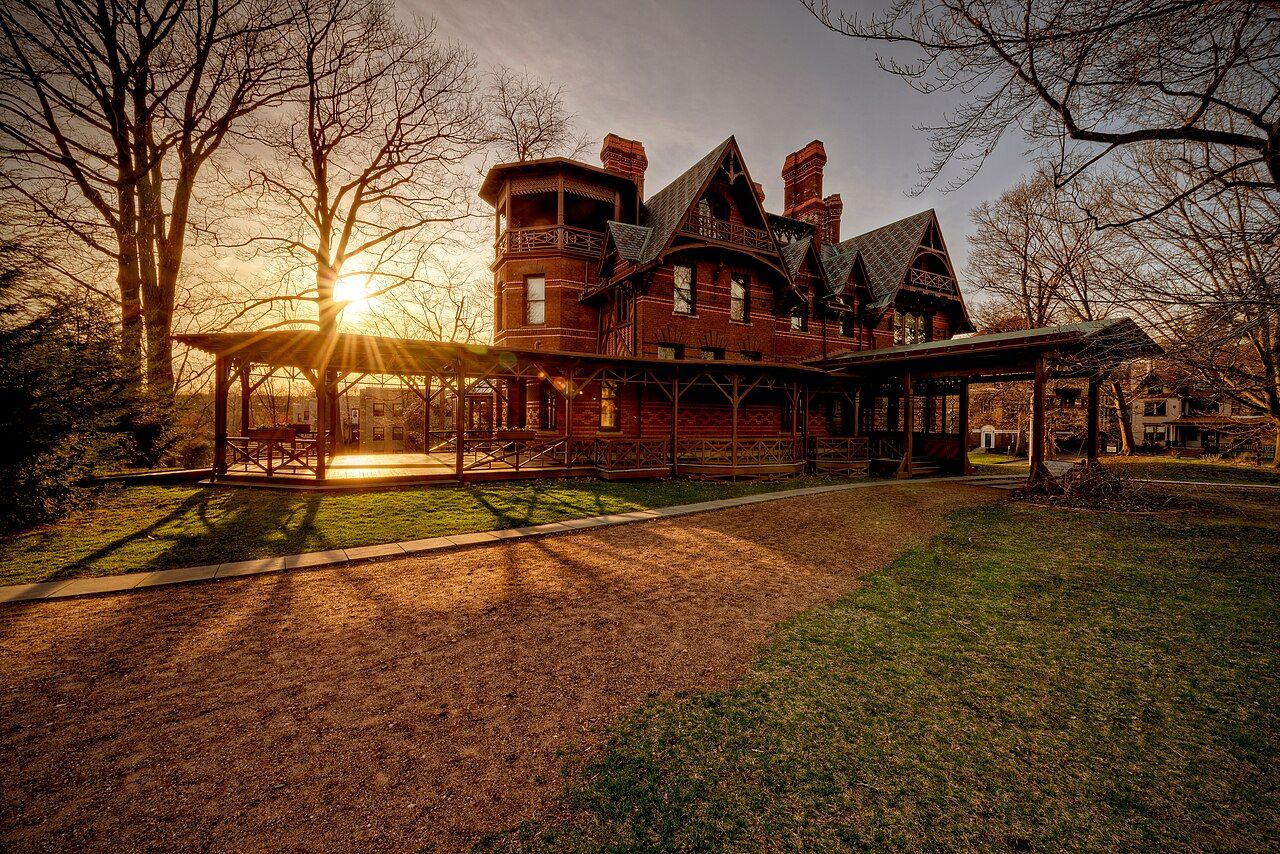
Hartford is Connecticut's capital, an insurance city on the Connecticut River that most travellers drive through on the way between New York and Boston. Stop on its west side, along Farmington Avenue, and you find one of the most remarkable literary neighbourhoods in the country. In the 1870s and 1880s Mark Twain and Harriet Beecher Stowe lived a lawn apart here, in a leafy enclave called Nook Farm, among editors, ministers, reformers and writers. Both houses are museums today, a few steps from each other.
Nook Farm
Nook Farm grew up in the middle of the nineteenth century as a tract of farmland west of the city centre, sold off in lots to families who knew one another. Many of them were connected to the Beecher family, Stowe's relatives, and to the causes of the day: the end of slavery, women's suffrage and church reform. Twain arrived in Hartford in 1871, rented in the neighbourhood and then built his own house. He found a ready audience and a co-author in his neighbour Charles Dudley Warner, with whom he wrote The Gilded Age, the 1873 novel that gave a name to the era.
The Twain house
The house Twain built with his wife, Olivia Langdon Clemens, is impossible to mistake: red brick laid in patterns, steep roofs, a tower and long carved porches, all of it unlike anything else on the street. The family moved in in 1874. In 1881 they had the main rooms redecorated by Associated Artists, the firm led by Louis Comfort Tiffany, and the stencilled walls, carved woodwork and glass give the interior a dark, glowing look.
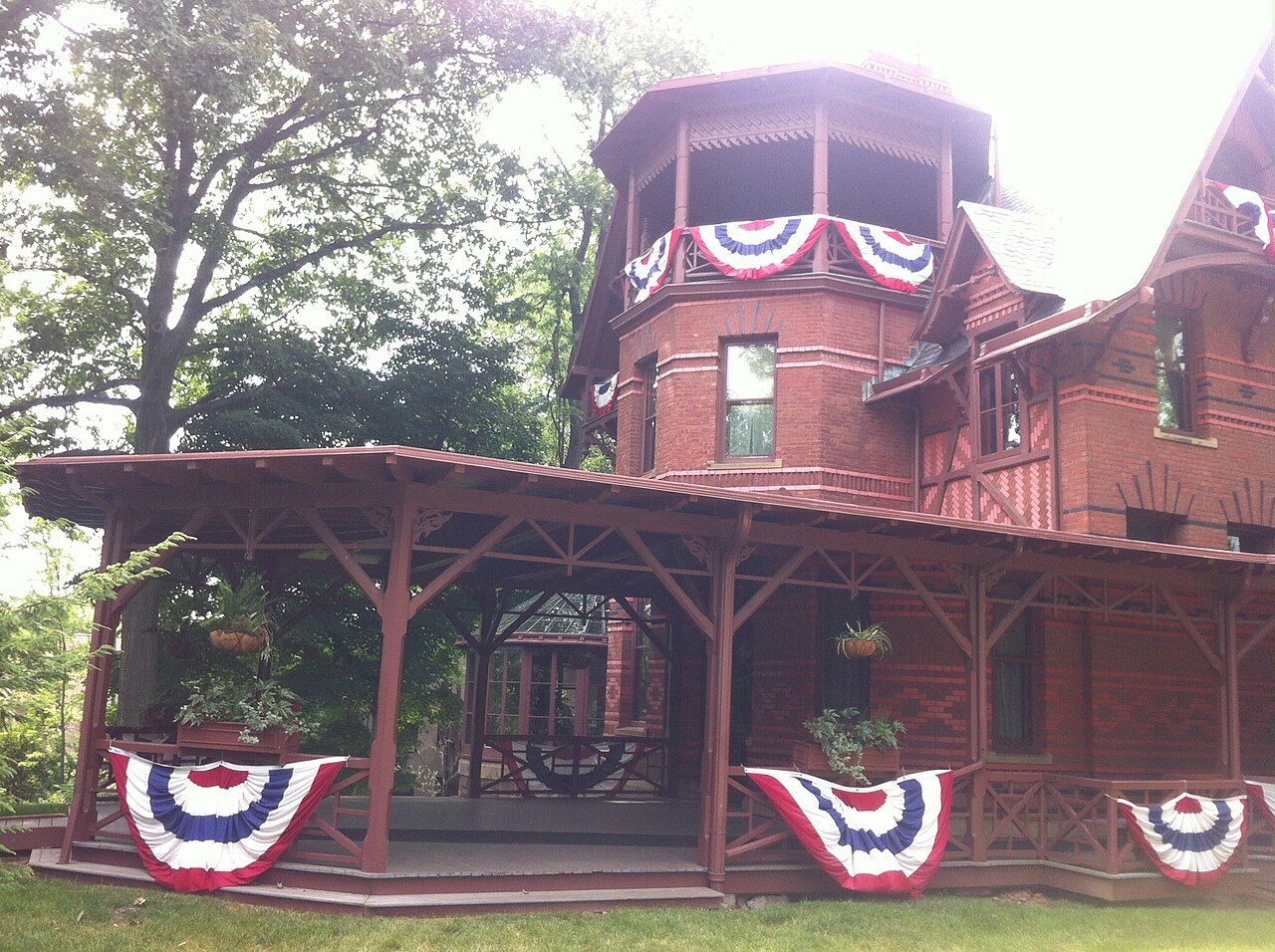
Tours are guided and follow a set route through the family rooms, the nursery and the conservatory, ending in the billiard room on the top floor, where Twain wrote. A modern museum centre beside the house holds exhibitions on his life and work, and it is where tours begin. Book ahead on weekends and in December, when the house is dressed for Christmas.
What Twain wrote here
The seventeen years the family spent in Hartford were the most productive of Twain's life. The Adventures of Tom Sawyer appeared in 1876, A Tramp Abroad in 1880, The Prince and the Pauper in 1881, Life on the Mississippi in 1883 and A Connecticut Yankee in King Arthur's Court in 1889. Above all he wrote much of Adventures of Huckleberry Finn here, on and off over several years, before it was published in the mid-1880s. The river town he had grown up in, Hannibal on the Mississippi, was half a continent away, but this is where he turned it into fiction.
Huckleberry Finn is a novel about a white boy and an enslaved man escaping down the river together, and it uses the racial slur of its time throughout. It has been challenged in schools for more than a century, and the house's guides and exhibits discuss that history directly rather than skipping past it.
Shelved nearby · NE 014Emily Dickinson's AmherstMoney trouble from bad investments sent the family to Europe in 1891. They never lived in the house again. In 1896 their daughter Susy died of meningitis in the house while her parents were abroad, and the family sold it a few years later.
Harriet Beecher Stowe's cottage
Stowe was already the most famous woman writer in America when she moved into the house on Forest Street in 1873. She had written Uncle Tom's Cabin years earlier in Brunswick, Maine; it ran as a serial and then appeared as a book in 1852, and it sold in enormous numbers in the United States and abroad. The novel turned many Northern readers against slavery in the decade before the Civil War. It also helped fix racial caricatures that outlived it, through stage versions that played for decades and through the insult its title character's name became. The Harriet Beecher Stowe Center, which runs the house, tells both parts of that story.
The house is a modest cottage compared with Twain's, full of her own paintings, furniture and books. Tours focus on her writing, her family and the reform movements around her, and they often end in discussion rather than a lecture. Stowe lived here until her death in 1896. She was born in Litchfield, Connecticut, an hour's drive west, if you want to follow her further.
The rest of the city
Downtown Hartford is a ten-minute drive east. The Wadsworth Atheneum, founded in 1842, is among the oldest public art museums in the country, and the gold-domed State Capitol overlooks Bushnell Park, one of the earliest city parks paid for with public money. The poet Wallace Stevens spent his working life here as an insurance lawyer and composed poems on his daily walk to the office; a marked walk follows his route, with stanzas of one of his best-known poems set in stone along the way.
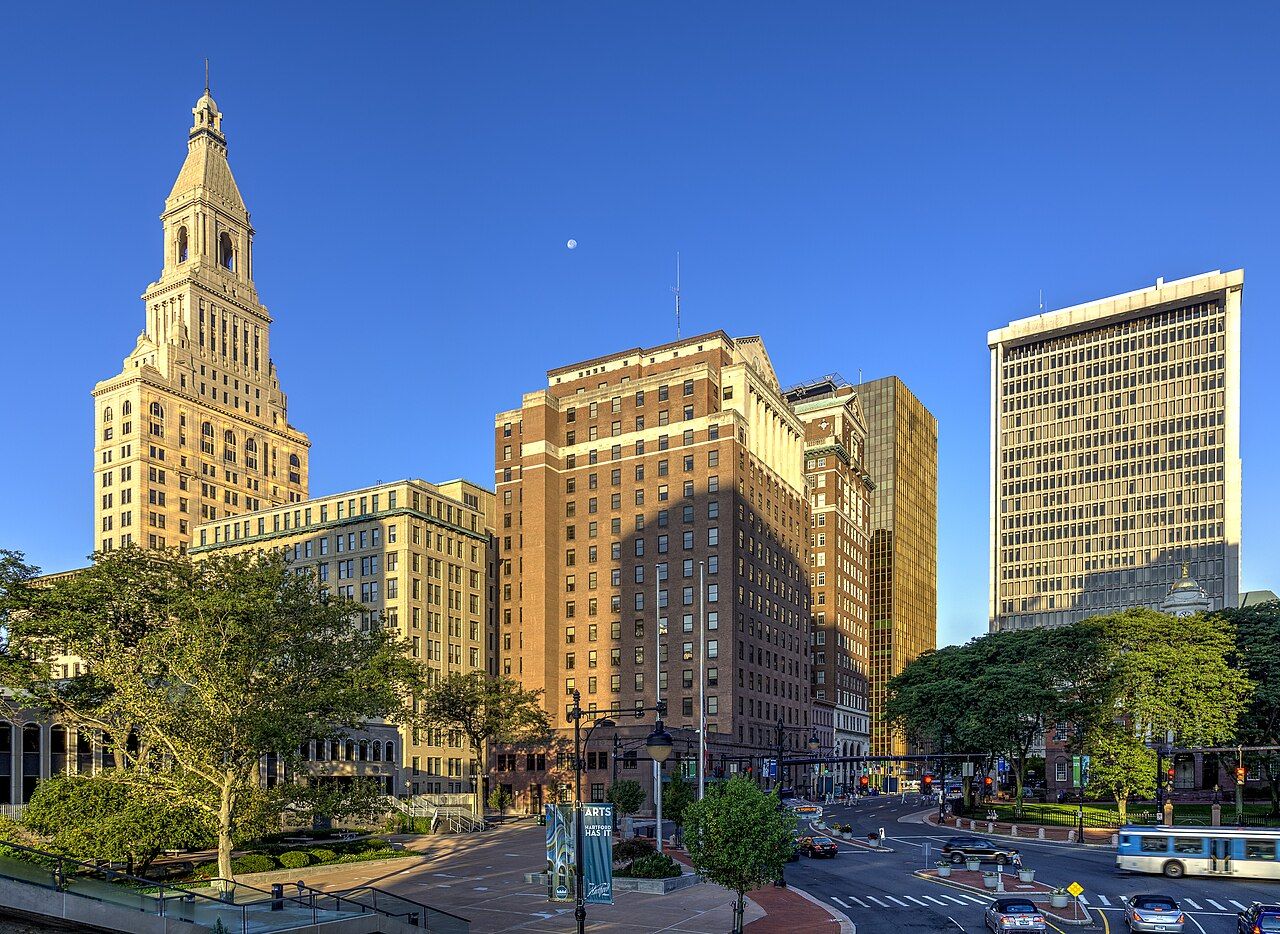
Hartford sits well on a New England route. Emily Dickinson's Amherst is about an hour north, Concord about two hours northeast, and the libraries and neighbourhoods of New York are around two and a half hours southwest by road.
Pictures on loan from
- TrigPhotography CC BY-SA 3.0
- AV Gonzalez CC BY-SA 4.0
- Kenneth C. Zirkel CC BY 4.0