
Great libraries · Boston
Boston Public Library, a palace that is free to all
On Copley Square, Boston built a library like an Italian palazzo and wrote over the door that it was free to all. The reading room, the murals and the courtyard still are.
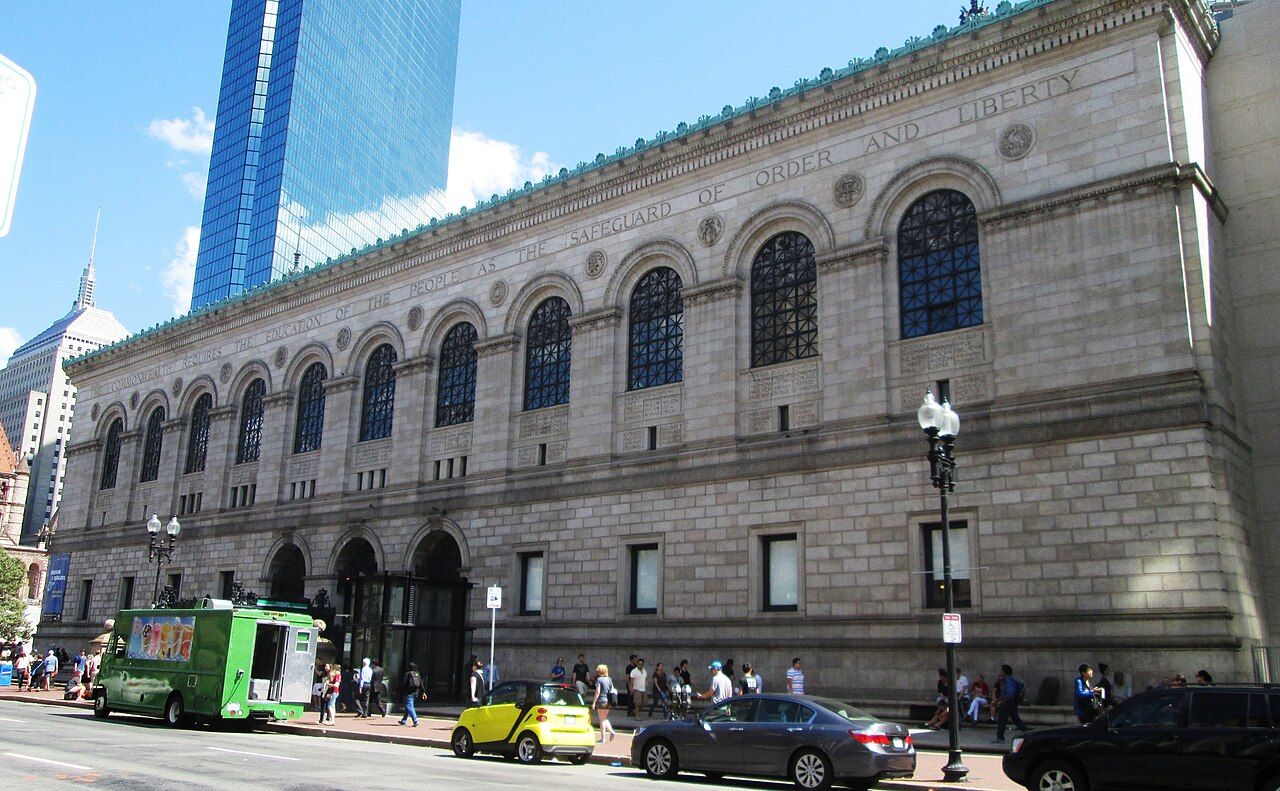
The Boston Public Library was founded in 1848 and opened its first rooms in the 1850s. It was among the first large free municipal libraries in the country, supported by the city's taxpayers and open to its residents, and the idea spread from here to towns across the United States. Its first great building on Copley Square, now called the McKim Building after its architect, Charles Follen McKim, opened in 1895.
The building was meant to make a point. Its long granite front faces the square like a Renaissance palace, and carved into the stone are the words Free to All over the entrance. Along the top runs an inscription stating that the education of the people is the safeguard of order and liberty. You are welcome to walk in, sit down and stay all day.
The McKim Building from the square
Stand on Copley Square first. Across the way is Trinity Church, with its heavy stone towers; the library answers it with a long, calm facade of arched windows. Between the windows the names of hundreds of writers, artists and thinkers are carved into the stone panels, and you can spend a while finding the ones you know.
The main doors, in bronze, are the work of the sculptor Daniel Chester French, who later made the seated figure in the Lincoln Memorial. Inside, the entrance hall leads to a grand staircase of yellow marble, guarded by two stone lions that commemorate Massachusetts regiments of the Civil War.
The murals on the stairs and walls
The library hired the leading painters of the day. On the walls of the main staircase, the French painter Pierre Puvis de Chavannes painted pale, quiet scenes of the Muses and the branches of learning. In a room off the second floor, Edwin Austin Abbey told the story of the quest for the Holy Grail in a long cycle of richly coloured panels.
On the third floor, in the gallery that bears his name, John Singer Sargent spent many years on a mural cycle he called Triumph of Religion. It is complex, uneven and fascinating, and some of its images of faiths and their histories have drawn criticism. The paintings were restored in the early 2000s and the gallery is worth the extra flight.
The library also keeps rare books, manuscripts and maps, and it shows some of them in changing exhibitions. Among its treasures is the personal library of John Adams, the second president, given to the city by his family, and a map centre on the ground floor holds exhibitions drawn from its large collection of historic maps. Check what is on display when you visit.
Shelved nearby · LB 105Inside the Library of Congress, from Jefferson's shelves to the domeBates Hall
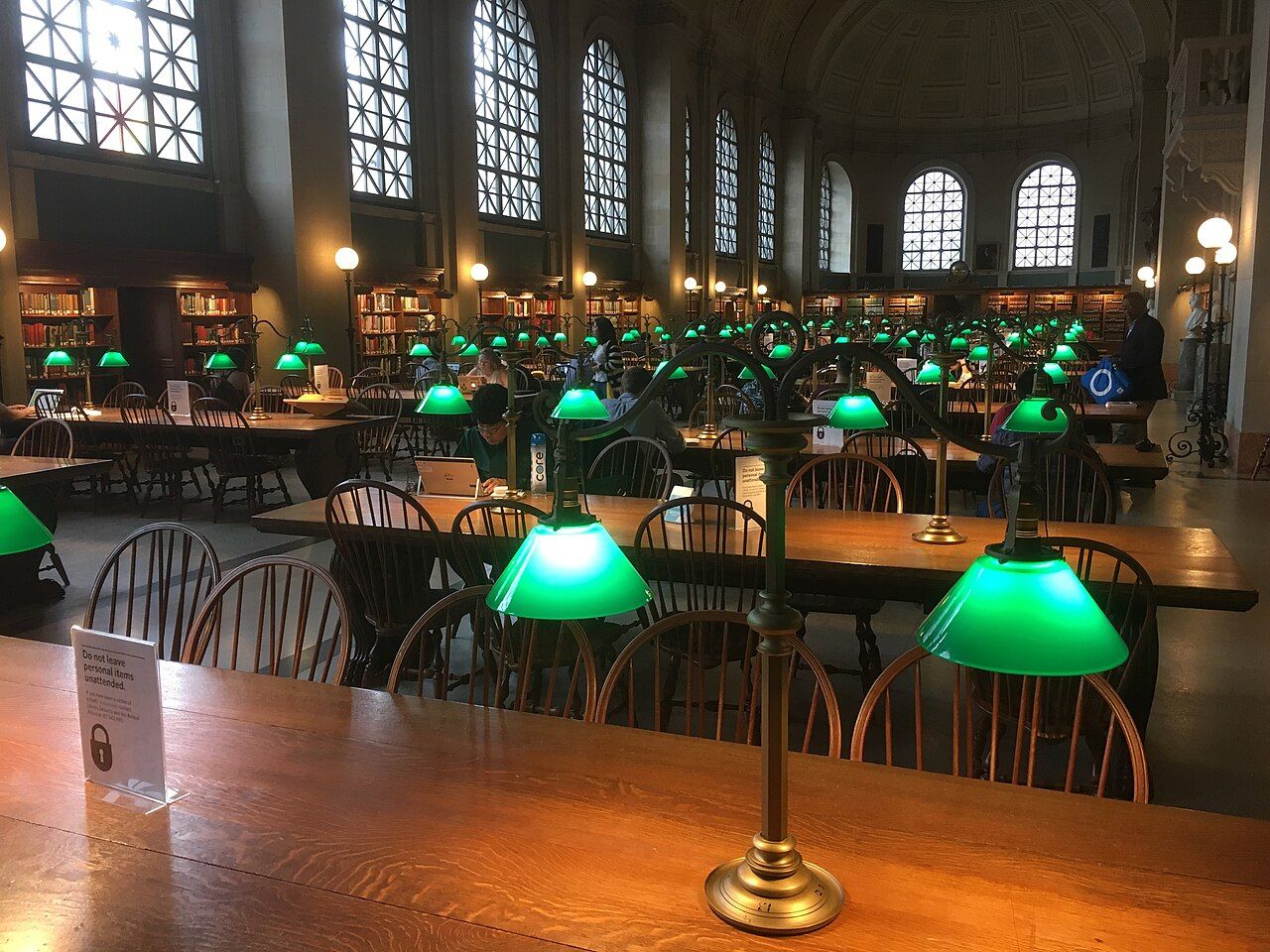
The reading room is named Bates Hall, after Joshua Bates, a Massachusetts-born banker in London who gave the library money and books in its early years. It runs nearly the length of the building's front, under a barrel-vaulted ceiling with half-domes at each end, lit by tall arched windows.
The long oak tables carry rows of green-shaded lamps, and the effect, when the room is full of people reading and working, is one of the finest sights in any American library. Anyone may sit here. Keep your voice down, keep food out, and let the room do its work. Readers who need the library's collections can ask at the desk about cards and access; residents of Massachusetts can usually get a card free of charge.
For literary Boston, the library is a good base. Henry James set The Bostonians (1886) among the reformers and lecture halls of the city, and the writers of Concord and Walden came into town to lecture, publish and argue. Their books are on the shelves in the building around you.
The courtyard
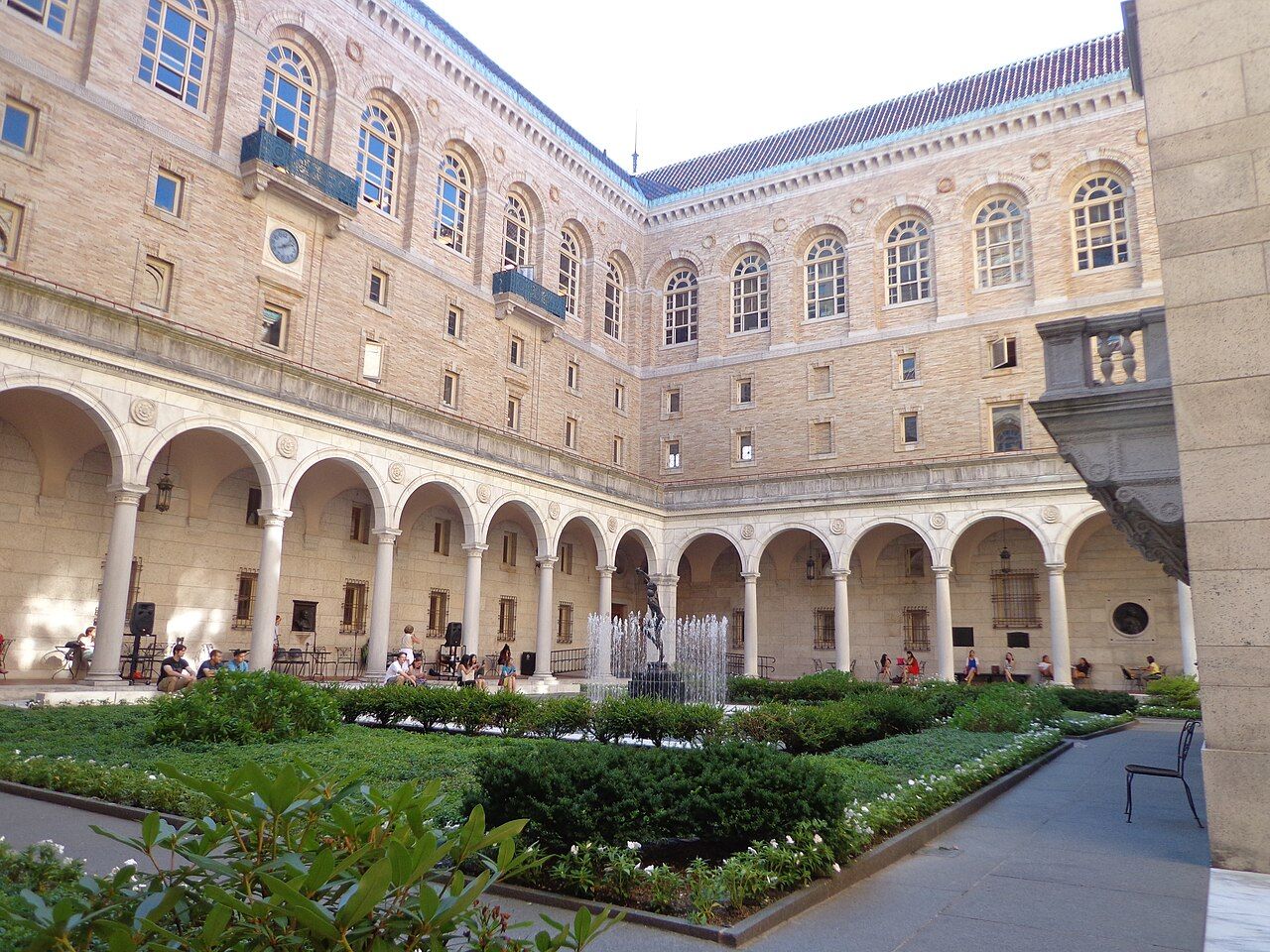
At the centre of the McKim Building lies an open courtyard, enclosed by an arcade of arches on slim columns. McKim based it on the courtyards of Renaissance palaces in Rome, and it feels a world away from the traffic of Boylston Street. A fountain plays in the middle, with a bronze statue of a dancing figure, a copy of a sculpture that so shocked some Bostonians in the 1890s that the original was taken away.
In warm months you can sit under the arcade with a book, and on some days the space hosts concerts and events. It is one of the calmest public spaces in the city, and it is free.
The courtyard is also the best place to see how the building works. The reading rooms, galleries and staircases are arranged around it on every side, so the arcade gives you a view of the whole structure and a sense of how carefully McKim planned the circulation of readers through it.
Planning your visit
- Entry is free. Opening hours vary by day and season; check before you go, especially on Sundays and holidays.
- Volunteer guides lead free art and architecture tours on some days. Times change, so check ahead.
- Copley station on the Green Line stops almost at the door. Parking nearby is scarce and costly.
- The newer Johnson Building, joined to the McKim, holds the main lending floors and a café.
From Boston, the drive west and north reaches Emily Dickinson's Amherst in about two hours, and Concord is less than an hour away. Hartford, with its Twain and Stowe houses, lies to the southwest on the way to New York.
Pictures on loan from
- Beyond My Ken CC BY-SA 4.0
- Ncysea Public domain
- Dbli4805 CC BY-SA 4.0
